EU Cyber Resilience Act: full application 11 December 2027. Reporting duties under Article 14 already apply.
Every requirement laid out in the regulation's own order, each one cited to the article it comes from — plus an Annex V Declaration of Conformity draft. It derives what your code can prove and tells you plainly which items only you can answer.
What it reads: a repository containing an npm manifest (package.json, plus package-lock.json / pnpm-lock.yaml / yarn.lock if present) or a Python one (pyproject.toml, requirements.txt, poetry.lock, uv.lock). Everything else comes from answers you type into ceproof.config.json — no repository scan can state your intended purpose or risk assessment. A C or C++ firmware project is not scanned, and the CRA profile takes no SBOM as input — SBOM import is FDA-profile only (--profile fda --sbom), and manual component lists are accepted on neither profile.
$99, one-time. Free scan and gap checklist.
Developers: npx ceproof scan — free, offline, no signup.
Four dates set by Article 71 of Regulation (EU) 2024/2847. Two of them are already behind us.
Article 71(2), verbatim: "This Regulation shall apply from 11 December 2027. However, Article 14 shall apply from 11 September 2026 and Chapter IV (Articles 35 to 51) shall apply from 11 June 2026." Source: Regulation (EU) 2024/2847 on EUR-Lex, consolidated text 02024R2847-20241120.
ceproof does not file or monitor these notifications; it drafts technical documentation. Article 14 is an incident and vulnerability reporting duty owed to a CSIRT and ENISA. It is listed here because it is part of why you are reading this page, not because this tool addresses it.
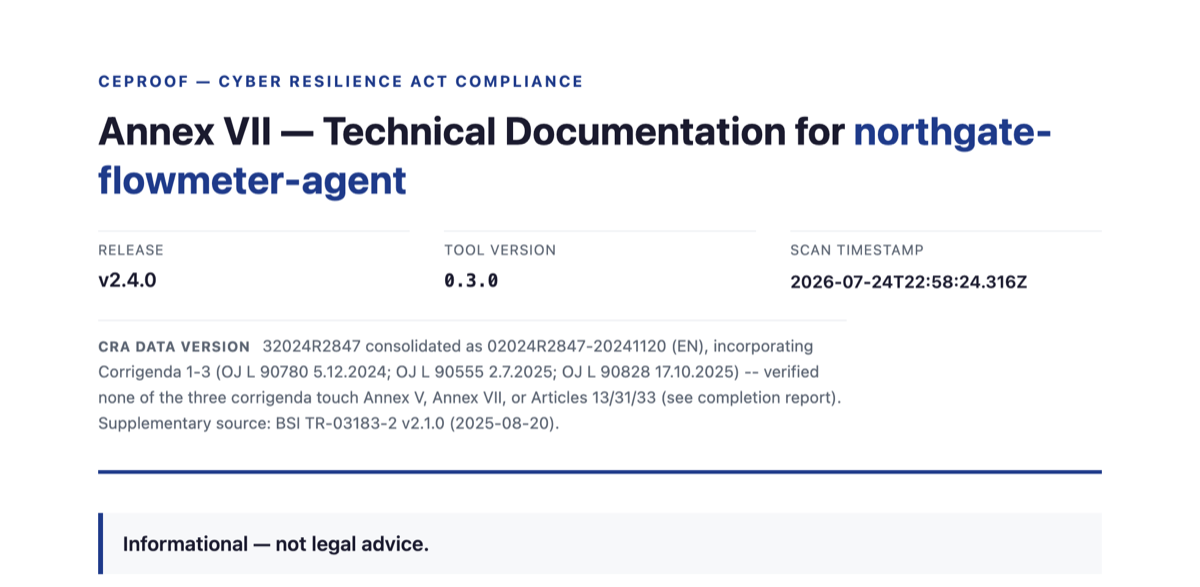
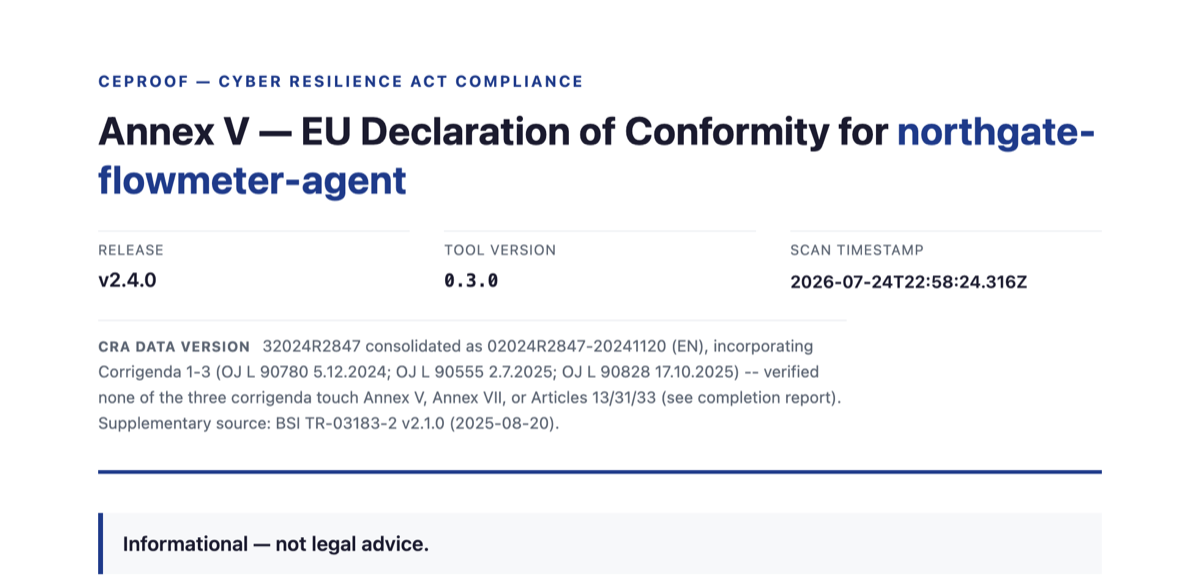
Both documents below are the tool's real output, published in full — generated, not mocked up, from a fictional example manufacturer (Northgate Devices GmbH).
Thirteen items, each with its citation, its status, and the literal scan evidence behind it. The cover carries the release it was generated against, the tool version, the timestamp, and which consolidated CRA text it was built from.
Read the full pack
Eight points in the model structure Annex V sets out, drafted from the same answers and the same scan, so the DoC and the technical file never drift apart.
Read the full draftThe pack states which consolidated text and which corrigenda it was built against: "32024R2847 consolidated as 02024R2847-20241120 (EN), incorporating Corrigenda 1-3 (OJ L 90780 5.12.2024; OJ L 90555 2.7.2025; OJ L 90828 17.10.2025) -- verified none of the three corrigenda touch Annex V, Annex VII, or Articles 13/31/33."
This page cannot answer that, and neither can the tool. What can be said, descriptively:
Confirm all of the above with counsel. ceproof produces a draft document; it makes no determination about your product's classification, and it never writes one into the output.
Article 31 provides that the technical documentation contains at least the elements set out in Annex VII. Article 28 provides that the EU declaration of conformity has the model structure set out in Annex V. Together that is 13 + 8 = 21 items. This table is generated from the same reference data the tool ships.
| Item | What the regulation asks for | Who can answer it |
|---|---|---|
| Annex VII 1(a) annex7.1.a |
General description of the product with digital elements, including its intended purpose. | Your answer |
| Annex VII 1(b) annex7.1.b |
General description must state versions of software affecting compliance with essential cybersecurity requirements. | Derived from your repository |
| Annex VII 1(c) annex7.1.c |
For hardware products, photographs or illustrations showing external features, marking and internal layout. | Your answer |
| Annex VII 1(d) annex7.1.d |
User information and instructions as set out in Annex II. | Your answer |
| Annex VII 2(a) annex7.2.a |
Necessary information on the design and development of the product, including drawings/schemes and a description of the system architecture. | Your answer |
| Annex VII 2(b) annex7.2.b |
Necessary information and specifications of the vulnerability handling processes: software bill of materials, coordinated vulnerability disclosure policy, contact address for reporting vulnerabilities, and secure update distribution. | Partially derived |
| Annex VII 2(c) annex7.2.c |
Necessary information and specifications of the production and monitoring processes of the product and the validation of those processes. | Your answer |
| Annex VII 3 annex7.3 |
An assessment of the cybersecurity risks against which the product is designed, developed, produced, delivered and maintained pursuant to Article 13, including how the essential cybersecurity requirements in Annex I Part I are applicable. | Your answer |
| Annex VII 4 annex7.4 |
Relevant information taken into account to determine the support period pursuant to Article 13(8). | Your answer |
| Annex VII 5 annex7.5 |
A list of the harmonised standards, common specifications, or European cybersecurity certification schemes applied (in full or in part), or descriptions of the solutions adopted where none were applied. | Your answer |
| Annex VII 6 annex7.6 |
Reports of the tests carried out to verify conformity of the product and of the vulnerability handling processes with the essential cybersecurity requirements in Annex I Parts I and II. | Your answer |
| Annex VII 7 annex7.7 |
A copy of the EU declaration of conformity. | Your answer |
| Annex VII 8 annex7.8 |
Where applicable, the software bill of materials, further to a reasoned request from a market surveillance authority. | Derived from your repository |
| Item | What the regulation asks for | Who can answer it |
|---|---|---|
| Annex V 1 annex5.1 |
Name and type and any additional information enabling the unique identification of the product with digital elements. | Your answer |
| Annex V 2 annex5.2 |
Name and address of the manufacturer or its authorised representative. | Your answer |
| Annex V 3 annex5.3 |
A statement that the EU declaration of conformity is issued under the sole responsibility of the provider. | Standard wording |
| Annex V 4 annex5.4 |
Object of the declaration (identification of the product allowing traceability, which may include a photograph, where appropriate). | Your answer |
| Annex V 5 annex5.5 |
A statement that the object of the declaration is in conformity with the relevant Union harmonisation legislation. | Your answer |
| Annex V 6 annex5.6 |
References to any relevant harmonised standards used, or any other common specification or cybersecurity certification, in relation to which conformity is declared. | Your answer |
| Annex V 7 annex5.7 |
Where applicable, the name and number of the notified body, a description of the conformity assessment procedure performed, and identification of the certificate issued. | Your answer |
| Annex V 8 annex5.8 |
Additional information: signed for and on behalf of (place and date of issue; name, function, signature). | Your answer |
Seventeen of twenty-one need a human. That is the honest shape of this problem, and it is why the tool does not try to autofill them. The same 21 items, with more on each →
On a typical repository with a tagged release and a resolved dependency tree, 2 of the 13 Annex VII items resolve fully from scan evidence alone, and a third gets partial evidence that still needs review. The rest describe things only a human can state honestly: intended purpose, design rationale, risk assessment, support-period reasoning, standards applied, test reports.
The value isn't autofill. It is the structure, the citations, the evidence the scan can genuinely prove, and regenerating the whole pack in one command on every release.
ceproof does not make you CRA-compliant. Conformity is a legal process involving your own assessment and, for some product classes, a notified body.
What ceproof gives you: the complete Annex VII and Annex V structure with every requirement cited to the regulation text, the evidence it can genuinely derive from your repository, your own answers assembled into a consistent document, and an explicit, honest list of what is still open. When it cannot evidence something, it says so out loud rather than filling the gap with something that reads well.
npx ceproof scan inspects a repository that has an npm manifest (package.json and any lockfile) or a Python one (pyproject.toml, requirements.txt, poetry.lock, uv.lock): security policy, vulnerability disclosure, update mechanism, VCS release identity, declared licence, and the full dependency tree. Without one of those manifests it refuses to run rather than guessing.
ceproof init writes a config file with one entry per item that genuinely needs a human: manufacturer identity, support period, vulnerability-handling process. It never guesses and never writes plausible-sounding filler into a legal document.
ceproof report renders the Annex VII technical documentation pack and the Annex V Declaration of Conformity draft as HTML or PDF, stamped with the release it was generated against. Offline. Your code never leaves your machine.
ceproof is written and supported by Mark Goldfinger, an independent developer in the United States who publishes two small command-line tools for software teams — this one and licenseproof. There is no company behind it and no sales team: support@ceproof.dev reaches the person who wrote the code, and the code is there to read.
Source-available under the Elastic License 2.0 — free to read, run and modify, not licensed for resale. That is not the same thing as open source, and this page won't call it that. How ceproof compares to the other CRA documentation tools →
The full scanner — gap checklist across all 21 items, init, JSON output, CI exit codes, and both SBOM formats (CycloneDX 1.6, SPDX 2.3). No account, no telemetry, no network calls.
$99 one-time
Unlocks the Annex VII technical documentation pack and the Annex V DoC draft, HTML and PDF. Includes 1 year of CRA reference-data updates. The tool never stops working — ever.
Buy$299 one-time
Everything in Individual, licensed for client work — generate packs for unlimited client projects. Includes 1 year of data updates.
BuyYour license key is emailed automatically as soon as payment clears. Perpetual means perpetual: past your update year, everything keeps working; you just don't pull newer reference data unless you renew.
For comparison: CRA consultancy engagements are commonly quoted in the thousands of euros per product (estimate; no specific provider surveyed). Doing it by hand is free, and the regulation text is free and public — the cost there is the reading, and keeping the document current across releases. The three options side by side →
If the pack doesn't do what this page says, email within 14 days for a full refund.
CRA deadline reminders by email. Double opt-in; unsubscribe anytime.
Download the blank Annex VII outline (PDF, free) — the 13 Annex VII headings with their citations and the verbatim regulation text, nothing filled in.
No. It assembles and structures your technical documentation and DoC draft with traceable citations. Compliance is a legal determination; have it reviewed.
A repository with an npm manifest (package.json, plus package-lock.json / pnpm-lock.yaml / yarn.lock if present) or a Python one (pyproject.toml, requirements.txt, poetry.lock, uv.lock). Without one of those, ceproof report refuses to run rather than producing a document off no evidence. A C or C++ firmware repository is not scanned, and the CRA profile takes no SBOM as input. Importing an SBOM you already have is FDA-profile only (ceproof scan --profile fda --sbom firmware.cdx.json, CycloneDX JSON spec 1.4–1.6); a component list pasted by hand is accepted on neither profile.
A minority, honestly. On a typical repository with a tagged release and a resolved dependency tree, 2 of 13 Annex VII items resolve fully from scan evidence alone, and a third gets partial evidence that still needs review — the rest describe things only a human can state honestly: intended purpose, design rationale, risk assessment, support-period reasoning, standards applied, test reports. The value isn't autofill — it's the structure, the citations, the evidence it can prove, and regenerating the whole pack in one command every release.
The Cyber Resilience Act applies from 11 December 2027 — that is when the essential cybersecurity requirements, including the Annex VII technical documentation and Annex V Declaration of Conformity obligations, take effect for products placed on the market (Article 71(2)). Two provisions already apply: Article 14's reporting obligation for actively exploited vulnerabilities and severe incidents has applied since 11 September 2026, and Chapter IV (Articles 35 to 51), on the notification of conformity assessment bodies, has applied since 11 June 2026. All four dates, with the quoted text.
Source-available under the Elastic License 2.0: the complete source is public on GitHub — free to use, audit, and modify; not licensed for resale. (The published npm package itself ships only the compiled tool and reference data, not the raw source — read the source on GitHub.) The scanner tier is free.
No. Zero network calls, zero telemetry — verifiable in the source. Everything generates on your machine.
npm, pnpm, yarn (classic + berry) · Python: uv, poetry, requirements.txt, pyproject. Mixed repos scan both at once. Nothing else is supported today.
CycloneDX 1.6, which meets BSI TR-03183-2 v2.1.0's stated version floor, and SPDX 2.3. BSI's floor for SPDX is 3.0.1 — a different data model, not a version bump — and support for it is on the backlog, not shipped. Both formats are free. Where the SBOM obligation actually sits.
If the pack doesn't do what this page says, email within 14 days for a full refund.
No — a real print-rendered document with provenance (tool version, CRA data version, release identifier, timestamp). Built to be filed.